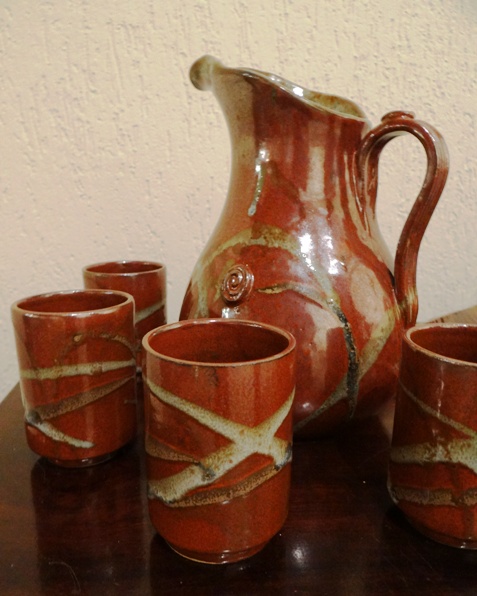
Tuesday, July 9, 2013

Pan


 1270ºC 

"A cozinha de um país é sua paisagem colocada na panela."

Provérbio Catalão

"The cuisine of a country it is a landscape placed in the pan."

Catalan proverb

Sunday, May 5, 2013

Between Hands


Terça dia 7 (das 14 às 16), quarta dia 8 de maio, (das 14 às 18h) e sábado dia 11 (das 14 às 16 horas) estarei no Flores na Varanda - Rua Camilo, 455 - Vila Romana - SP.
" Entre Mãos" de 07 à 19 de Maio de 2013.

Forno elétrico 1260ºC


Tuesday, April 30, 2013

Watermelon Glaze


Click the image to enlarge


1260ºC - Electric fire

Esmalte Melancia
Watermelon Glaze


Sunday, April 28, 2013

Volutas volúveis ao vento


 Estas volutas podem ficar soltas em giro ou acomodadas em paredes. 
Quando soltas emitem um delicado som em choque com as contas. 
Queima a gás, 1300ºC,  com aplicação de óxido de ferro. 

These volutes will work loose, suspended in rotation. Or can stay on walls.
When suspended and  loose, it emits a delicate sound when clashing the beads.
Gas fired, 1300ºC, with iron oxide coating.


As espirais me acompanham desde a juventude. Sempre gostei de desenha-las, de tê-las por perto. Durante a época que estudei música, me encantava com a voluta do meu violino. Do mar, sempre coleciono conchas espiraladas...

Hoje, na cerâmica, as volutas nascem do movimento natural do torno. Lembram-me que é na origem de qualquer ação que há a concentração de energia necessária para sua continuidade. As espirais são otimistas, me dão força, me inspiram a continuar o movimento ritmado de expansão e superação nos vários aspectos da vida.


Spirals follows me since youth. I always liked to draw them, to have them around. During the time I studied music, I was enchanted with the volute of my violin. From the sea, I always collect spiral shells...

Nowadays, on pottery, volutes rise from the natural movement of the wheel. Reminding me that it is in the origin of any action where there is the energy concentration required to the continuity. Spirals are optimistic, give me strength and inspire me to continue the rhythmic movement of expansion in the various aspects of life.


Saturday, April 27, 2013

Between Hands - Exposition


A arte cerâmica acontece entre as mãos. Numa espécie de dança diária dos movimentos cotidianos, as peças cerâmicas flutuam entre mãos e superfícies, criam novos gestos, surpreendem ao abrirem espaço para apreciação, oferecem outra relação tempo/espaço. Alma que reivindicou forma, poema tátil em barro inscrito, a cerâmica revela as mãos e o coração, de quem a faz, e de quem a recebe. 
Acácia Azevedo.

Ceramic art happens between hands. In a kind of everyday dance of movements, the ceramic floating between hands and surfaces, creating new gestures, surprising when opening space for enjoyment, offering another relationship between time and space. Souls that claims for shapes, tactile poem inscribed in clay, pottery reveals hands and hearts from those whom make and receive it.
Acácia Azevedo


Friday, April 26, 2013

May 28th - Latin American Potter´s Day

Electric fired - 1260ºC

A utilização de cerâmicas autoral no cotidiano é um hábito recente 
para as pessoas por aqui. 

Nossa cultura cerâmica nasceu na baixa temperatura, das culturas indígena e sul- americana de um modo mais geral; onde a cerâmica acabou ganhando espaço nos jardins, nos alguidares cheios de frutos sobre as mesas, nos filtros e bilhas de água fresca que nosso clima tropical pede. 

Já a cerâmica de alta temperatura veio até nós por influência europeia, americana... No estado de São Paulo, é forte a presença da cultura japonesa. E eles dominam a alta temperatura, conhecem o material e têm nos ensinado sua versatilidade, suas técnicas, sua filosofia. 

Os japoneses não têm peças iguais para todos da família. Cada um escolhe sua peça de acordo com seus costumes diários, hábitos alimentares, seu gosto, seu jeito. O Japão é um país de estações bem definidas. E como as sakuras mudam seu aspecto com o clima, os japoneses trocam suas cerâmicas de acordo com as estações. Levam para casa algo como a alegria do verão, a clareza do inverno, o frescor da primavera, os tons quentes e nebulosos do outono. 

Aqui não, aqui temos o apego ao jogo de jantar completo e sentimos muito a perda de cada peça. Diferenças... Por outro lado, somos um povo jovem, aberto às novidades. E a cada dia aumenta o número de pessoas que querem algo mais do que um simples copo de vidro ou aquela xícara de café industrial igual a mil outras. 

Queremos algo especial, que reconforte a alma, tanto quanto o cafezinho do intervalo do dia. No momento de receber aquele amigo querido, aquele parente que amamos, um simples copo de água oferecido em uma cerâmica, muda tudo, cria outro gesto, outro momento, outros assuntos. Assim também é nas reuniões formais, onde a cerâmica utilitária toma seu sofisticado ar de requinte e indiscutível bom gosto. 

Pois somos assim, desejamos uma surpresa para os olhos que termine por aquecer o coração, que nos lembre de quem realmente somos e o que sonhamos. Isso é a cerâmica utilitária para mim e para algumas pessoas que começam a afinar os olhos, as mãos, os gestos, para a novidade que é a experiência de 
ter a cerâmica no seu dia a dia. 

Aprendi essas coisas com a minha mestra no torno, Hideko Honma Sensei. Aprendi também com minhas alunas em seu processo de evolução. Aprendi com as pessoas que vêm até minha casa, ao meu Studio, compram minhas peças e comentam; felizes como crianças na loja de brinquedos fazendo suas escolhas tão honestas. A boa cerâmica é assim, física, se dá nos encontros. Como um abraço bem brasileiro, nossa cerâmica deve ser também calorosa. 

Abrir-se para a experiência com a cerâmica utilitária é levar arte para seu cotidiano. É aprender sobre seus processos, sobre nossa história. E desta forma também, prestigiar os ceramistas que estão por ai perto de você, revivendo entre mãos esse processo ancestral e em contínua evolução. Historicamente a cerâmica revela não apenas o avanço tecnológico de um país, como também a identidade, influências, peculiaridades e sensibilidades de seu povo. E é assim que a cerâmica autoral brasileira está crescendo, com nossa dedicação, com nosso jeito de sentir e ver o mundo. 

A cada peça que faço, imagino as mãos que irão acolhê-la, penso na infinidade de sonhos, penso no conforto, penso em como provocar outra respiração. Não sei se consigo. Mas desejo intensamente em todos meus projetos, linhas, gestos, superfícies, texturas, cores, tornar cada peça de cerâmica uma espécie de janela voltada para o que há de melhor em nós mesmos. 

por Acácia Azevedo.


Electric fired - 1260ºC


The use of handmade pottery in daily life is a recent habit for Brazilians.

Our culture in ceramics came from low firing, mostly from the indigenous cultures of Brazil and South America, where pottery just gained space in gardens; table bowls plenty of fruits, water filters and jugs of fresh water that our tropical climate asks for.

But the high fire ceramics came to us by European influence, American... Also, at São Paulo city there is a big Japanese colony with strong presence of Japanese culture. And they dominate the high fire, they know the materials and have taught us their versatility, their techniques, their philosophy.

The Japanese have no equal pottery for all family. Each family member chooses his/her pottery according to their daily habits, eating habits,, their way of life. Japan is a country with well-defined seasons. And as the sakura change its appearance following the weather, the Japanese exchange their ceramics according to the seasons. They bring to home something like the joy of summer, bright of winter, the freshness of spring, the warm and fuzzy autumn.

It’s not happen in Brazil. Here we have that kind of feeling to the complete set of dinner we may have inherit and we feel a lot the loss or missing of each piece. Differences ... On the other hand, we are a young country, open to new things. And every day increases the number of people who wants something more to their lives than a simple glass or one industrial porcelain cup of coffee equal to a thousand others.

We need something special, that can relief and reassure the soul as much as the coffee we drink on the afternoon break. While celebrating with one dear friend, that relative we love, a simple act like to offer water in a ceramic cup, changes everything, creates another gesture, another time, other subjects.  It is valid for formal meetings too, where utilitarian pottery takes its sophisticated air of refinement and unquestionable taste.

We want a surprise for the eyes that ends up warming the heart, remembering us who we really are and what we dream about. This the way that the utilitarian pottery touches me and others that now begin to sharpen the eyes, the hands, the gestures, using and feeling the experience of pottery in their life. 

I learned these things with my master and teacher, Hideko Honma Sensei. I also learned from my students in the process of evolution. I learned from the people who come to my house, my studio, and buy my artwork and comment; happy as kids in a toy store doing your choices so honestly. 

The good pottery is like that: physical, tactile poem. It occurs magically on meetings. Like a Brazilian hug, our ceramic must be warm. 

Open yourself to the experience with the  handmade pottery is to bring art to your everyday life. You learn about their processes, about their history. Support potters that are near you, between their hands this ancient process is a never ending evolution. 

Historically, pottery reveals not only the technological advance of a country as well as the identity, influences, peculiarities and sensitivities of the people. And that is the way that signature Brazilian pottery is growing, with our dedication to our way of feeling and seeing the world. 

Every piece I do, I imagine the hands that will welcome it, hold it. I think about the multitude of dreams, think about comfort, about how to take another breath of emotion. I don’t know if I can. But I wish from the bottom of my heart that all my projects, lines, gestures, surfaces, textures, colors, make each piece of pottery a kind of window facing and mirroring the best in ourselves.

by Acácia Azevedo

Wednesday, April 24, 2013

I learn a lot from you!

 Andrea 

Liliane

Ao torno, essas duas estão demonstrando muita determinação, evoluem à passos largos!
Aulas de tono, Studio Acácia Azevedo em Vinhedo -SP

----

 Tati

 Ana Laura

Juliana

Modelagem Manual - Atelier Hideko Honma - São Paulo - SP

Peças de modelagem manual Tatiana Kawata

Peças modelagem manual Renata Veinert

Pinch pot, com encaixe perfeito, por Juliana.

Saturday, April 20, 2013

Craft and art

Forno elétrico, 1260ºC 


About craft and art


"Craft is one of the visual arts.  It focuses on a close relationship to materials and processes. In the simplest way, that is what it is. That doesn’t mean that it can’t be everything else, that when you work with materials you don’t bring your entire life’s biography into it, that you don’t have ideas that flow through it. But, ultimately, it is different from other fields in that it has a material and process intensity, and that is also its problem. Now, as art is going multimedia, you can work with any material, change, shift processes. If there’s a store in town, a junk-pile somewhere you can drag something out of, you can migrate from one material to another. Crafts is a difficult issue for our culture today because it takes, depending upon the field, anywhere from 7 to 10 years to develop that extraordinary intimacy with the  materials. The other thing that makes it different, and this is probably a personal bias, craft is to my mind at its best when it is dealing with sensuality. When it starts putting on all those little footnotes from art history, it tends to get a little more tiresome than when it grabs you by the throat and thrills you because of something that you see that is completely abstract that has no narrative whatsoever. That’s something that it does that, at least in fine arts, you don’t experience that much." 

Garth Clark

Sobre artesanato e arte*

"O Artesanato é uma das artes visuais. É concentrado em uma estreita relação de materiais e processos. De forma mais simples, é o que é. Isso não significa que o artesanato não possa ser tudo o mais, que quando você trabalha com materiais não possa trazer toda sua biografia para ele, que não possamos ter ideias que fluam através dele. Mas, em última análise, é diferente de outras áreas em que há o material e a intensidade do processo, o que as vezes também pode ser um problema. Agora que a arte está se tornando multimídia, podemos trabalhar com qualquer material, mudar, trocar de processos. Se há um ferro velho na cidade, uma pilha de sucata em algum lugar, podemos tirar algo de lá, podemos migrar de um material para outro. Artesanato é uma questão difícil para a nossa cultura de hoje, porque as vezes, dependendo do campo em que se trabalha, necessita-se algo em torno de 7 a 10 anos para desenvolver essa intimidade extraordinária com os materiais. Outra coisa, em minha opinião, que possibilita extrairmos o melhor do artesanato, e isto é muito pessoal, é quando lidamos com a sensualidade. Quando começamos a colocar todas as notas de rodapé da história da arte, ela tende a ficar um pouco mais cansativa do que quando ela agarra você pela garganta e o emociona, por causa de algo que você vê e é completamente abstrato, e que não tem qualquer narrativa. Isso é algo que o artesanato faz, e, pelo menos em artes plásticas, não temos a oportunidade de experienciar tanto esta sensação. "

Garth Clark
*Tradução livre, grifo meu.
   Free translation, emphasis mine.

Sunday, March 17, 2013

II Encontro Internacional de Ceramistas na USP 2013


  Com coordenação da Profa. Dra. Norma Tenenholz Grinberg e da Profa. Dra. Cristiana Aun Bertoldi e com a Secretaria Executiva de Sérgio Grinberg, o II Encontro Internacional de Ceramistas na USP foi um sucesso. Trouxe o prestígio e o conhecimento de grandes nomes da cerâmica nacional e internacional, repetindo o sucesso da primeira edição do evento. É sempre uma grande oportunidade poder participar deste ambiente tão rico em troca de informações e experiências. Toda a equipe de organização está de parabéns!

Under Prof. Norma Tenenholz Grinberg, PhD coordination and the Prof. Cristiana Aun Bertoldi, PhD and under the Executive Secretary Sérgio Grinberg, the II International Artistic Ceramics Meeting at USP (São Paulo University) was a big success. It brought the prestige and knowledge about the big names in national and international ceramics scenario, repeating the first edition success. It’s always a great opportunity to join this atmosphere so rich in exchange of knowledge and experiences. All the organization team is to be congratulated!


(Click nas imagens para amplia-las)
(Click on images to enlarge)

Meu destaque vai para as palestras da
Diretora do Museu Ariana (da Cerâmica e do Vidro) de Genebra, MSc Isabelle Naef Galuba.
Palestras:
- Através das Coleções do Museu Ariana - Uma história da Cerâmica,  e
- De Bonifas a Barde: Destaques da Cerâmica Suíça dos Séc. XX e XXI.

My highlight goes to the
Director of the  Ariana Museum (Ceramics and Glass) from Geneve, MSc Isabelle Naef Galuba.
Lectures:
- Trought the Ariana Museum Collections - A Ceramic History,   and
- From Bonifas to Barde: Highlights of Swiss Ceramic in the 20th and 21th centuries.

 A delicada técnica e o interessante percurso artístico de. Karen Gunderman - Artista e professora da Milwaukee University (EUA)

The delicate technique and interesting artistic pathway of  Karen Gunderman - Artist and teacher at University of Milwaukee (USA)

 O criativo, carismático e multicultural Christopher Benevides, artista e professor da Milwaukee University (EUA). 

The creativeness and charisma of the multicultural Christopher Benevides, artist and professor at  Milwaukee Univeristy (USA).

A escultora Esther Shimazu nasceu no Havaí e reside nos EUA. Sua escultura é construída parte por parte do corpo e montada para formar um oco contínuo, cada um é detalhadamente trabalhado.

Esther Shimazu, was born in Honolulu, Hawaii, and lives in USA. Each stoneware sculpture is constructed body part by body part and assembled to form a continuously hollow, handcrafted to the detail.


 Sempre inspirando e dando dimensão e poesia ao fazer cerâmico, Megumi Yuasa, Grupo Iandê - Brasil.
Always inspiring and giving dimension and poetry to the ceramic, Megumi Yuasa, from Iandê Group - Brazil.


Profa. Lorena D´Arc e A Produção Cerâmica Contemporânea Mineira.
Profa. Lorena D'Arc, Contemporary Ceramics in Minas Gerais- Brazil.


 Amélia Siegel Correa é socióloga. E, através da Secretaria de Cultura do Paraná, trouxe notícias sobre o Salão Paranaense de Cerâmica. O fato é que as reivindicações, os milhares de e-mail enviados, as movimentações nas redes sociais e outras manifestações realizadas por ceramistas do Paraná, e de todo o Brasil, surtiu resultado. (para entender mais, veja este post anterior e este outro, de fev/2012). O Salão tem data marcada para este ano, 12 de dezembro na Casa Andrade Muricy, em Curitiba. É uma conquista. Mas muito ainda precisa ser feito para que esta realização mantenha sua qualidade e prestígio. E, infelizmente, o Congresso não será realizado. Amélia deixou seu e-mail, para contatos e sugestões: ameliasiegelcorrea@seec.pr.gov.br


Amélia Siegel Correa is a sociologist. And, through the Paraná’s Culture Secretary, brought us news about the Paranaense Exhibition of Ceramics. The fact is:  the claims, the thousands of e-mails sent, the social networks mobilization and other claims made by the Paraná state artists, and all Brazilian artists, finally brought results ( to know more about it, go to this post and this other one, from Feb. 2012). The Exhibition now has a date scheduled for Dec. 12th,  at Andrade’s Muricy House, in Curitiba. It’s an accomplishment. But there are still many things that has to be done for the maintenance of the quality and prestige of this event. And, unfortunately, the Congress will not happen. Amélia  gave her e-mail, for contact and suggestions: ameliasiegelcorrea@seec.pr.gov.br


O Encontro foi muito rico e contou com a participação de vários palestrantes, como as ceramistas artistas Heloisa Alvim (Brasil), Vilma Villaverde (Argentina), Dalcir Ribeiro (Encontro de Ceramistas de Paraty), Caio e Paschoal Giardullo (Contaf), Léa Diegues (Cerâmica Arteminas), Antonio Carlos de Camargo (Vice presidente da ABC) e o editor chefe da revista New Ceramic, Bernard Pfannkuche.

The II International Artistic Ceramics Meeting at Sao Paulo University was very important and had the participation of several speakers, as the ceramic artists Heloisa Alvim (Brazil), Vilma Villaverde (Argentina), Dalcir Ribeiro (Cermics Meeting in Paraty), Caio and Paschoal Giardullo (Contaf), Léa Diegues (Ceramic-Arteminas), Antonio Carlos de Camargo (Vice President of ABC) and the Chief- Editor of New Ceramic magazine.

Até o próximo! 
Now, waiting for the next!


Detail of  Prof.Christopher´s T-shirt ;D